
Arbitration
This guide walks you through the arbitration lifecycle and resolution flow.
Arbitration serves as the final, legally binding stage of a dispute resolution process, occurring only when the initiating and receiving parties fail to reach an agreement during preliminary cycles. In this phase, the case is escalated to an independent governing body or committee that conducts a definitive review of all submitted evidence to determine liability. Because this stage often carries significant administrative fees and its ruling cannot be appealed, it acts as a "court of last resort" to ensure a conclusive end to the dispute lifecycle.
Arbitration is part of the extended dispute lifecycle, defined here.
Arbitration Lifecycle
Note: There are currently no actions available at the arbitration phase.

Status Definitions
Understanding arbitration states helps you track progress and know what actions are available:
| State | Description |
|---|---|
| OPEN | Ready for available actions (currently none are possible) |
| UNDER_REVIEW | An arbitration committee is actively reviewing all evidence |
| WON | Arbitration committee ruled in the merchant's favor |
| LOST | Arbitration committee ruled in the consumer's favor |
Supported Payment Methods
The following payment methods utilise arbitration:
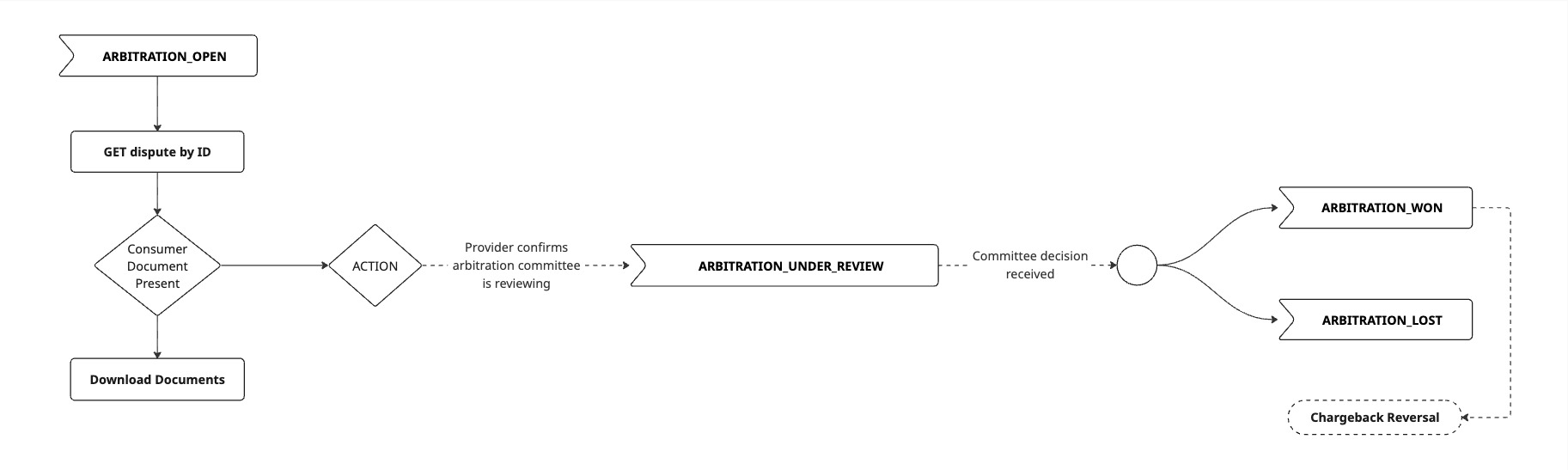
Arbitration Resolution Flow
1. Receive arbitration notification
When a dispute is escalated to arbitration against a merchant account, an ARBITRATION_OPEN webhook notification is sent to the registered endpoint.
2. Retrieve arbitration details
Retrieve detailed information about the dispute, including the reason, status, any files and messages, as well as allowedActions and allowedCapabilities. Full list of reason codes can be accessed here.
API endpoint: GET /v1/disputes/{disputeId}
When to use:
- Immediately after receiving
ARBITRATION_OPENwebhook - To check current status of in-progress disputes
Important: There are currently no
allowedActionsorallowedCapabilitiesduring arbitration. Retrieving details is used to view any additional messages or files added since the earlier stages.
3. Download consumer files (when available)
Download any documentation or evidence submitted by the consumer/ consumer bank.
API endpoint: GET /v1/disputes/{disputeId}/files/{fileId}
The response provides:
- A time-limited download URL for secure file access
- File metadata (name, type, size)
When to use:
- After retrieving arbitration details (if files are attached)
4. Track dispute resolution
Webhook events:
ARBITRATION_UPDATEDARBITRATION_WONARBITRATION_LOST
Possible final outcomes:
| Status | Meaning | Impact |
|---|---|---|
| WON | Arbitration committee ruled in the merchant's favor | Merchant retains funds, the chargeback is reversed, dispute closed. |
| LOST | Arbitration committee ruled in the consumer's favor | Dispute is closed. |
Updated about 22 hours ago